



Transport
Sustainable Transportation at Dokuz Eylul University
Transportation is one of the key components of Dokuz Eylul University’s Green Campus strategy. The University aims to reduce greenhouse gas emissions, improve accessibility, and promote healthier mobility by encouraging public transportation, walking, cycling, shared mobility, and low-emission vehicles.
Today, Dokuz Eylul University serves a campus population of 62.408 students, academic staff, administrative personnel, and visitors. Approximately 1300 cars and 600 motorcycles enter the campuses daily, while the University operates a fleet of 92 institutional vehicles for academic, administrative, healthcare, and technical services. Despite this large transportation demand, the ratio of combustion-engine vehicles to the total campus population remains only 0.032, reflecting the University’s continuous efforts to promote sustainable mobility and reduce dependence on private vehicles.
Public Transportation and Free Campus Shuttle Services
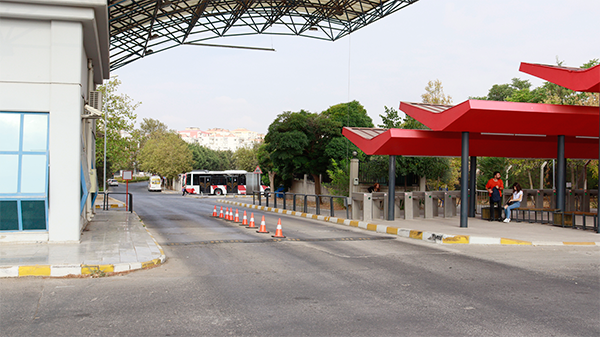
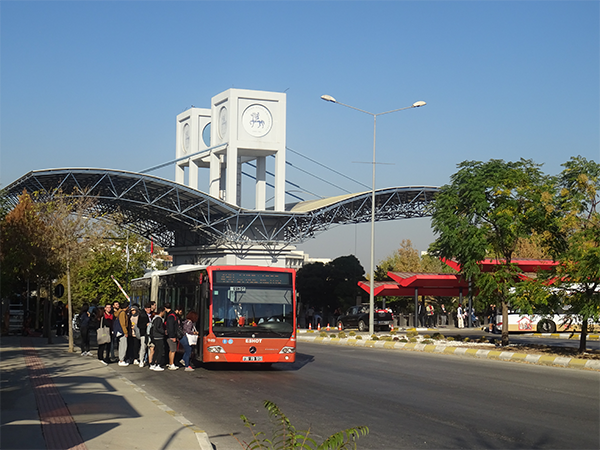
Public transportation is the primary mode of access to Dokuz Eylul University campuses. Numerous municipal bus lines connect different parts of İzmir directly to the campuses, providing convenient and affordable transportation for students and staff.
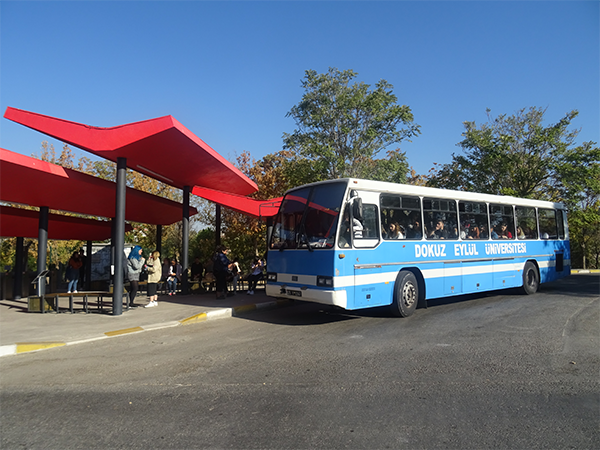
Because the Tınaztepe (Central) Campus covers a large area, the University also operates a free campus ring shuttle service connecting faculties, laboratories, administrative buildings, libraries, cafeterias, dormitories, and social facilities. The shuttle performs approximately 18–20 trips every day, allowing users to move easily across the campus without relying on private vehicles.
An important development in recent years has been the extension of İzmir’s urban rail transit system to the campus entrance. During the construction period, municipal buses have been temporarily allowed to operate inside the campus and reach the farthest academic units. Thanks to this improvement, the demand for the internal shuttle service has decreased, and the number of shuttle trips has been reduced by approximately 50%, demonstrating the increasing use of public transportation.
A Campus Designed for Walking and Cycling
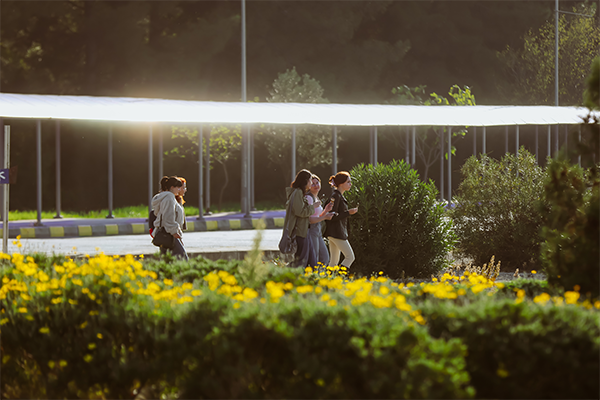
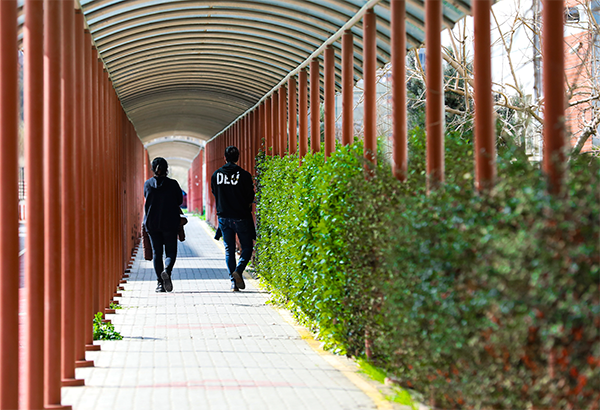
Dokuz Eylul University encourages walking as the preferred mode of transportation within its campuses. Wide pedestrian roads, covered walkways, landscaped pathways, seating areas, and safe crossings provide comfortable access between academic buildings, green spaces, and social facilities.
At the Central Campus, pedestrian pathways surround almost the entire campus, allowing users to move safely without intensive interaction with motor vehicle traffic. Many pedestrian routes are covered, protecting users from both sun and rain, while nighttime lighting systems improve visibility and safety after dark.
Accessibility is another important priority. Pedestrian routes include ramps, tactile paving, and suitable walking surfaces that support individuals with disabilities and ensure equal access throughout the campuses.
To further encourage active transportation, bicycle lanes, bicycle parking facilities, scooter stations, and shared electric scooters are available in several campus areas. The University has also adopted the DEU Pedestrians and Cyclists Declaration, reinforcing its long-term commitment to sustainable mobility and pedestrian-oriented campus planning.
Limiting Private Vehicle Use
Reducing private vehicle use is one of the University’s long-term transportation policies. Since 2017, parking capacity has remained fixed, and no additional parking areas have been developed despite the continuous growth of the university community.
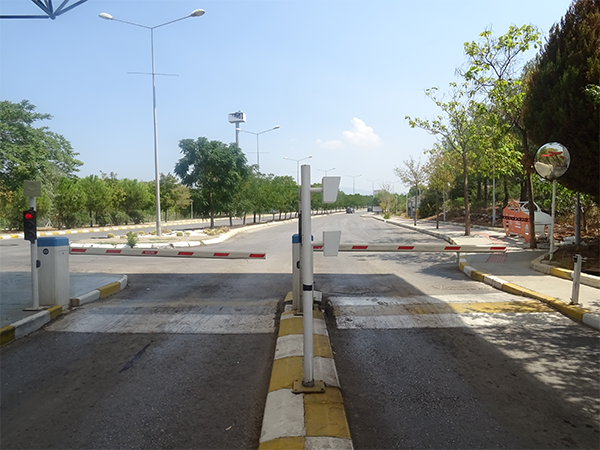
Access to campus parking areas is managed through the DE-HGS digital license plate recognition system, which permits entry only to registered vehicles. This smart access control system improves security, prevents unnecessary vehicle circulation, and helps reduce traffic congestion within the campuses.
One of the University’s most significant achievements has been the reduction of parking space. Between 2017 and 2021, the total parking area decreased from 86,900 m² to 40,000 m², corresponding to a 54% reduction. Today, parking areas occupy only 0.72% of the University’s total campus area, demonstrating DEU’s commitment to preserving green spaces while prioritizing pedestrians, cyclists, and public transportation. Rather than expanding parking infrastructure, the University focuses on managing existing parking areas more efficiently.
Dokuz Eylul University continues to expand low-emission transportation alternatives across its campuses. Shared electric scooters provide practical mobility for short-distance travel, while bicycle infrastructure encourages environmentally friendly transportation between faculties and social facilities.
Electric vehicles are also increasingly used, particularly within the University Hospital for patient transportation and operational services. To support the transition towards cleaner mobility, seven electric vehicle charging stations have been installed on different campuses, and additional charging stations are planned in the coming years. These investments encourage the adoption of electric vehicles while contributing to lower greenhouse gas emissions and improved campus air quality.
Smart Transportation Management
Digital technologies play an increasingly important role in the University’s transportation strategy. The University’s Vehicle Tracking System (VTS) continuously monitors institutional vehicles using GPS-based technologies. The system enables route optimization, fuel management, maintenance planning, and real-time vehicle monitoring, helping improve operational efficiency while reducing unnecessary fuel consumption and emissions.
Together with the DE-HGS access control system, the Vehicle Tracking System supports evidence-based transportation management by improving traffic safety, optimizing resource use, strengthening institutional transparency, and reducing the University’s overall carbon footprint. The system directly contributes to seven United Nations Sustainable Development Goals, including sustainable cities, climate action, responsible resource use, innovation, and institutional governance.